Why Your Bra Cups Gap at the Top (And How to Fix It)
We’ve all been there. You find a cute bra in your size—let’s say a 34A. You put it on, scoop and swoop, and everything feels okay... until you look down.
There it is: the dreaded gap.
There is a hollow, empty space between the top of your breast and the rim of the cup. Or maybe you put on a tight white t-shirt, and you can clearly see the outline of the bra cup sticking out, hovering over your skin rather than hugging it.
It is one of the most frustrating experiences for women with petite busts. It often leads to a cycle of self-doubt: “Am I actually an AA cup? Do I need to stuff this? Are my boobs just too small for bras?”
We are here to tell you the most important thing you will read today: There is nothing wrong with your body.
If your bra cups gap at the top, it rarely means your boobs are "too small" for the size. It almost always means you are wearing a bra designed for a breast shape that you don’t have.
Here is the real reason why that gap happens—and why the solution isn't a smaller size, but a smarter style.
The #1 Culprit: "Shallow" vs. "Projected" Breasts
To understand why your bra is gaping, we have to talk about breast geometry.
In the lingerie world, breast shape is generally categorized in two ways regarding how the tissue sits on your chest wall: Projected and Shallow.
-
Projected Breasts: Think of a drinking glass. The tissue has a smaller base (or "root") on the chest but sticks out farther.
-
Shallow Breasts: Think of a soup bowl or a dinner plate. The breast tissue is spread over a wider area of the chest wall, but it doesn't stick out as far.
Here is the problem: Most standard bras—especially those molded foam t-shirt bras found in big department stores—are designed for projected shapes.
These cups are manufactured with a fixed deep curve. They expect your breast tissue to be concentrated in the center and to project forward to fill the deepest part (the apex) of the cup.
If you have a shallow shape (which is very common for petite busts), your volume is distributed differently. You might have plenty of volume at the bottom or sides, but because your tissue sits closer to the chest wall, it doesn't reach the "tip" of that deep, molded cup.
The result? The bottom of the bra might fit you perfectly, but the top section remains empty. The stiff foam holds its own shape rather than molding to yours, creating that annoying ridge or gap at the neckline.
You aren't missing breast tissue; your bra is just expecting it to be in a different place than it actually is.
Why "Going Down a Size" Usually Doesn't Work
When you see a gap in your 34A, your instinct is logically to try a 34AA. It makes sense: If there is empty space, the cup must be too big, right?
Wrong.
While sizing down might technically eliminate the gap at the top, it usually introduces a new, more painful problem: The Wire Width.
Bra grading is specific. When you go down a cup size, manufacturers don’t just make the cup shallower; they make the underwire narrower.
Remember how we established that many petite women have "shallow" breasts? Shallow tissue tends to be spread out wider across the chest (closer to the armpit).
If you size down to fix the gap, the narrower wire of that AA cup will likely end up sitting on top of your breast tissue at the side, rather than encircling it.
So, you are left with a choice: A bigger cup that gaps (annoying), or a smaller cup that digs in (painful).
The Solution? Stop changing the size, and change the material.
You don't need a smaller cup volume. You need a cup profile that is flexible enough to hug your shape exactly where it is. This is where moving away from rigid foam padding changes everything.
The Solution: Why Unlined, Stretch Lace is Better Than Padding
For decades, the lingerie industry has sold a lie to small-busted women: “If you want shape, you need padding.”
It makes sense in theory—add foam, get volume. But in practice, molded foam is the enemy of the shallow breast.
Because molded foam is rigid, it forces your breast to conform to its shape. If your tissue doesn't perfectly match the mold (which, for most of us, it doesn't), the foam stands away from the body. It’s like wearing a shoe that’s two sizes too big; it looks clunky and feels awkward.
The Fix? You need a material that moves with you.
This is why unlined, stretch lace is the ultimate "gap-proof" solution. Unlike stiff foam, high-quality stretch lace acts like a second skin. It doesn't demand that your breast fill a specific pre-set mold. Instead, it expands over the tissue you have and lays flat where you don't.
The "Hugging" Effect
The secret to eliminating the gap is looking for a bra with an elasticized top line.
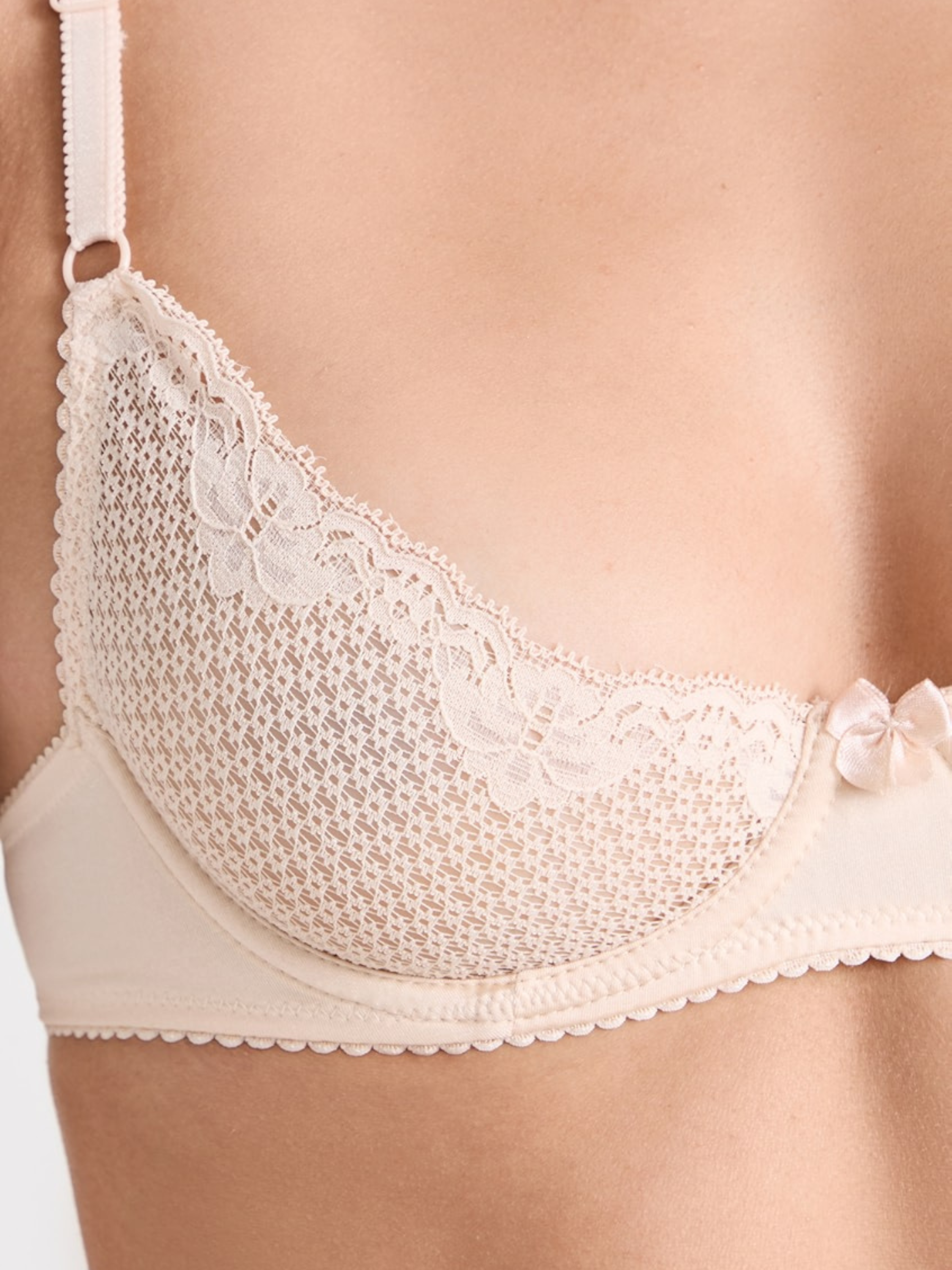
A bra designed specifically for petite frames, like the Alice Demi bra, utilizes a crochet lace that has a significant amount of stretch.
-
When you stand straight: The lace hugs your curves gently.
-
When you lean forward: The elastic edge stays flush against your skin.
-
When you move: The bra moves with you, maintaining that smooth silhouette under your clothes.
By ditching the padding, you aren't "losing" size. You are gaining a silhouette that actually fits. And surprisingly, the right unlined bra often creates more cleavage than a padded one because it scoops and lifts the tissue you have, rather than burying it under an inch of foam.
Meet the "Gap-Proof" Bra: The Alice Demi Bra by Timpa Lingerie

If there is one bra that has reached "cult status" among petite women for solving the gaping problem, it is the Alice Demi bra (known to many long-time fans as the Timpa Duet).
While most brands just shrink down their larger cup designs, the Alice was engineered from the ground up specifically for the petite, shallow bust. It doesn't try to force your body into a new shape; it celebrates the shape you have.
Here is exactly why the Alice succeeds where t-shirt bras fail:
-
The True Demi Cut: The Alice has a very low-cut, "demi" silhouette. By lowering the neckline of the bra, we remove the upper section of the cup entirely. If there is no fabric at the top, there is nothing to gap. It’s simple geometry.
-
The "Memory" Lace: The signature crochet lace used in the Alice isn't just for looks. It has a high elastic content with incredible memory. It expands to fit the fuller part of your breast and snaps back to hug the shallower upper slope. It creates that smooth, flush fit that usually only comes with custom lingerie.
-
The Side-Scoop Construction: Instead of padding you out, the Alice is constructed to scoop you in. The wire width and cup shape work together to gather breast tissue from the side and lift it forward. This creates natural cleavage and fullness without a single millimeter of foam.
It is the perfect example of "less is more." By removing the excess coverage and rigid foam, you finally get a bra that looks like it was made for you, not just bought by you.
3 Signs You’ve Finally Found the Right Fit
Once you switch from a molded cup to a stretch lace demi like the Timpa Alice, the difference in fit is usually immediate. But if you’ve been wearing the wrong size for years, a "correct" fit can sometimes feel different than what you are used to.
Here is how you know you have found the perfect match for a petite frame:
-
The "Flush" Test: When you run your finger along the top edge of the cup where the lace meets your skin, it should feel smooth. There should be no ridge of fabric standing up, and no cutting in that creates a "quad-boob" effect. The lace should simply lie flat against your chest wall.
-
The Wire Width: The underwire should sit comfortably behind your breast tissue, near the armpit—not on it. Because the Alice is designed for petite frames, the wires are scaled to be narrower, ensuring they encircle your breast tissue fully without poking your ribs.
-
The Natural Lift: You should see a lifted, rounded shape that moves when you move. If you lift your arms or twist your torso, the bra should stay in place while the stretch lace adapts to your motion. No more adjusting or tugging at your bra straps throughout the day!
Conclusion: Stop Filling the Gap
For too long, petite women have been told that if a bra gaps, they need to fix their body—usually by hiding it under thick padding.
It is time to stop fighting with molded foam cups that were never designed for your unique shape. The "gap" isn't a sign that you have nothing to put in the bra; it’s a sign that the bra isn't doing its job.
By switching to an unlined, elasticised lace bra like the Alice Demi bra, you can finally get the support, lift, and sexy silhouette you deserve—without the empty space.
Ready to say goodbye to the gap? Shop the Alice Demi Bra Here!